How Meridian West helped ACCA unlock the power of its Global Talent Trends research
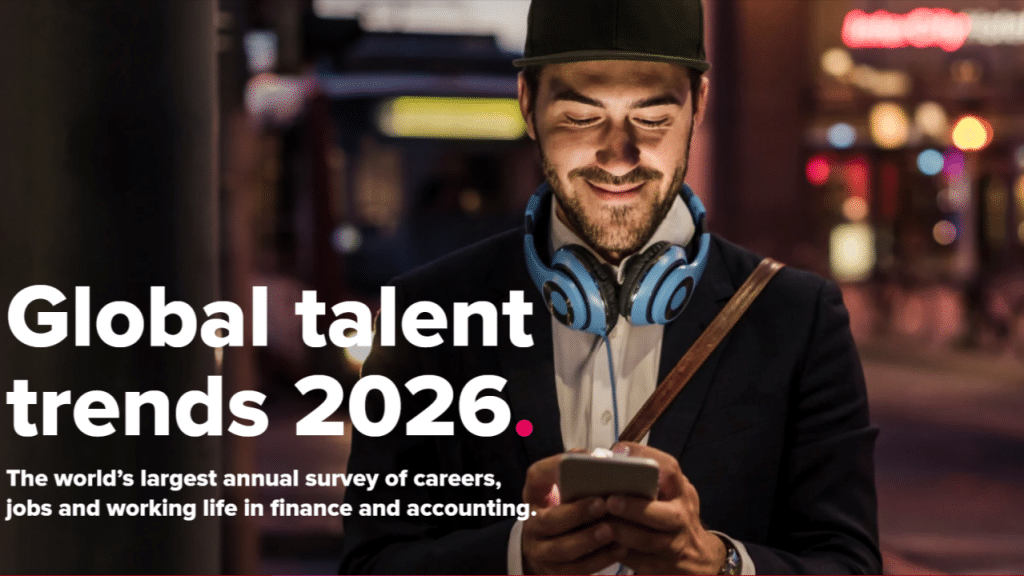
An 11,000-person survey across 160 countries does not automatically produce insight. More often, it produces too many plausible stories, conflicting regional signals and a difficult editorial choice about what deserves the headline. That is why the ACCA approached Meridian West to support on the analysis and visualisation of the 2026 Global Talent Trends report.
In a recent webinar, Jamie Lyon FCCA, the ACCA’s Global Head of Skills, Sectors, and Technology, sat down with Bertie Heppel, Director at Meridian West, to discuss the perils of working with large datasets, how advanced analysis techniques can get to the nub of a story, and how organisations can make the most of their research data.
The challenge: why bigger samples make editorial choices harder
Launched several years ago and now run every year, the ACCA’s Global Talent Trends survey is the biggest talent and work study for finance and accountancy professionals in the world. But for all its scale and ambition, the Global Talent Trends report presents serious practical challenges. The first, as Jamie readily acknowledges, is simply getting the numbers in the first place.
“Survey fatigue is just a huge issue. 11,000 people – it takes a lot of work to generate that sort of engagement.”
But securing responses is only half the battle. Large datasets create a dangerous illusion: that the main story will announce itself. In practice, the opposite happens. A result may be strong globally but weak in a major region. A generational divide may disappear once seniority is stripped out. A finding that suits the institution’s existing narrative may be less durable than a messier one that cuts across markets.
“You can’t report on everything. Less is more. You have to be quite judicious in terms of which things do we really want to talk about, and which things maybe can we hold back and talk about at a different time.”
There is also the challenge of diversity of output. The ACCA serves a vast range of audiences: members in emerging economies and established markets, senior finance leaders and early-career professionals, those in the Big Four and those in small practices. Communicating the research effectively across all of these groups requires not just great content, but careful thinking about how that content is activated and delivered.
It was these challenges – the sheer volume of data, the need for cut-through, and the desire to bring in fresh analytical perspectives – that led ACCA to approach Meridian West for support.
“I’ve been in the profession for about 32 years, so I’ve been around a lot. And I think it’s always useful just to have an organisation like yourselves come in and sort of look at some of the data and almost challenge it back.”
The process: ‘spreading the data on the table’
Meridian West’s relationship with the ACCA spans several projects, including work using CoreClarity to support the analysis of qualitative insight streams. For the Global Talent Trends project, however, the brief was primarily quantitative – and so required a different approach.
“I just need you to throw this data across the table for me. Because I’m drowning a little bit, right? And trying to put it all in one place where you can start to see it.”
Meridian West’s response was to build an interactive data dashboard using DisplayR, designed to give Jamie and his team a dynamic, visual tool through which to explore the full dataset. The dashboard allowed the ACCA team to interrogate the data across the full range of segmentations – region, seniority, generation, sector, and more – and to begin identifying correlations and emerging narratives that would otherwise have remained buried.
In addition to the dashboard, Meridian West provided analytical support, including work on data segmentation and cluster analysis, trialling approaches that helped surface the distinct ‘types’ of employees visible within the data. The aim throughout was to give the ACCA something interactive: not simply a set of outputs, but the tools to continue exploring and understanding the data themselves.
The results: faster, sharper, more cohesive
The dashboard transformed the way Jamie and his team was able to engage with the data, not just speeding up the analytical process, but changing its quality.
“I found it a very methodical way of just being able to look at all the questions that we’d asked, and then think about how, if people had responded to this question, how had they responded to that question. So you start to see some of the correlated data – maybe where there starts to be cause and effect around things as well.”
The ability to see the data rendered immediately in charts was particularly valuable – not just for analytical purposes, but for thinking ahead to how findings might ultimately be presented and communicated.
“It gives you a quicker sense of what the main themes may be. But it also gives you a sense of how you want to play this stuff out when you produce content – what does this look like in terms of how you might want to visualise it? It just allowed me to start to expedite how we started to think about how we might present some of the data. It’s just super efficient. Super visual. It just helps you navigate the story much more quickly and much more easily.”
The end result was a more cohesive, confident research narrative. With so much data available and so many possible directions to explore, the dashboard gave the team the clarity to focus on what mattered most – quickly identifying the headlines, the big issues, and the stories that the 2026 report would be built around.
Making the research go further
Producing a flagship global report is one thing. Getting sustained value from it is another. The ACCA has developed a deliberate strategy for maximising the longevity and reach of the Global Talent Trends research.
One key approach is regionalisation: the ACCA produces dedicated Africa, Asia Pacific, and other regional reports, drawing on the same underlying data. This allows the organisation to bring local nuance and relevance to discussions around the world, responding to what Jamie describes as a degree of ‘de-globalisation’ in how professionals want to consume research.
“People want to understand how they compare to their peers in their regions and markets. If you’ve got the data to do that – which we have – it’s incredibly valuable. It allows us to take content out on the ground across the world and just bring a bit more local nuance and context.”
The ACCA also uses Global Talent Trends as a convening tool, hosting events and facilitating dialogues that invite members, employers, and sector leaders to engage with the findings, share their own experiences, and connect the data to what is happening in their organisations.
Finally, the ACCA actively joins the dots between Global Talent Trends and its wider programme of research. The organisation works to ensure that its thought leadership speaks with a consistent voice – using the talent data to enrich economic and sector analysis, and vice versa.
“The threads are really important. It’s about the themes that cut across. We use our Global Talent Trends research, and we promote it through other pieces of research as well. We’re going out to the market with one voice and a consistent opinion around things.”
Meridian West’s Tips and Tricks for B2B Thought Leadership