

Our NPS database shows something we haven’t seen for a few years: a dip in client feedback scores across the professional services landscape.
Is this trend real and, if so, what’s behind it?
Our view is that firms’ client service is not getting worse; clients are simply expecting more.
Our Meridian West database contains results from multiple waves of client-listening research and covers feedback from tens of thousands of clients. One of the key metrics it tracks is Net Promoter Score (NPS), which has become a widely used shorthand for client advocacy across professional services.
Our recent CLIMB research report shows that over three quarters of firms include NPS in their client listening programmes, with this increasing to 82% among the most ‘advanced’ programmes, which track not only their own progress year on year but also how they compare with competitors.
What is the benchmark telling us?
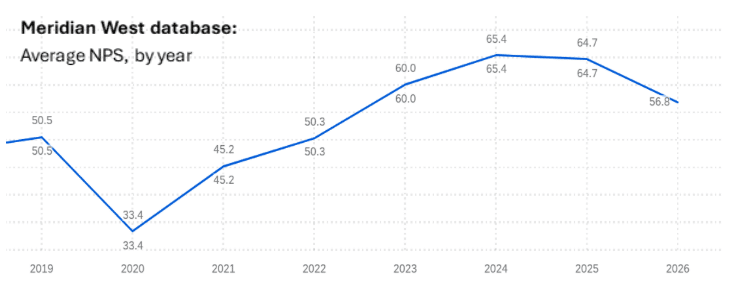
There was a clear dip in 2020, unsurprisingly, as the pandemic forced every firm to rethink how it served clients. Since then, there has been steady improvement, peaking at an average NPS of 65.4 in 2024.
This year, however, that has changed. The average has fallen significantly for the first time since 2020, from 64.7 in 2025 to 56.8. Is this a blip that will level out, or a sign of something more significant?
We don’t expect scores to return to 2020 levels, but we do believe this to be a meaningful dip. Rather than reflecting a decreasing focus on client service, it indicates a shift in clients’ expectations and in what they define as excellent client service.
What, then, is driving the change, and how should firms respond? The following trends appear most consistently in our client research. They will not apply equally to every firm, nor are they the only factors at play, but they recur across the professional services landscape.
Four shifts stand out: responsiveness has become a baseline rather than a differentiator; clients expect more tailored value-add; inconsistent team delivery is exposing over-reliance on individual relationships; and AI is raising expectations around speed, cost and transparency. Alongside these changes, selective face-to-face contact is regaining importance as a way to strengthen relationships.
Responsiveness is the baseline, and clients now expect more proactive and tailored advice
Responsiveness remains central to client satisfaction. It is usually the first thing clients pick up on when things go wrong. Interestingly, however, it seems to be cited less frequently as a standout strength.
The standard has tightened. The “reply within 24 hours” rule seems to have shortened to within a few hours, and timely communication on matter updates, including general progress and fees, is now a service fundamental.
With service standards and guidelines in place, most firms largely meet them. That just doesn’t get you noticed any more.
What clients consistently ask for now is proactivity:
“If I ask them a question and I want to discuss a topic, they are very forthcoming and will give me lots of information and help me think about things from different angles. But I don’t generally get an email saying, ‘Have you thought about this?’ or ‘Such and such an estate’s doing this, have you considered it?” – Finance Director, real estate management firm
Clients don’t just want you to respond to a problem; they want you to spot it first and come to them with advice and recommendations. That goes well beyond matter or project updates.
“I would just prefer them to be that little bit more individualistic when it comes to issuing advice and understanding that being on the front foot, being proactive in advising us, considering how well they know us.” – Owner, private estate
Clients increasingly seek value-add
As client service levels remain high across the board, firms now set themselves apart by showing that they truly understand their clients’ business priorities, anticipate their needs and issues, and help them move work forward by providing more commercial insight.
What was traditionally seen as “value-add” is a major part of this.
Clients tell us they want concise, relevant updates rather than generic newsletters, along with practical guidance, horizon-scanning and tailored training.
“What I prefer is a partner to pick up the phone and say, ‘Did you know this is probably relevant to you?’”– Managing Director, specialist engineering firm
There is a catch: proactivity must be useful rather than promotional. Clients quickly reject generic content and poorly targeted cross-selling, so outreach should be timely, relevant to the client’s priorities and grounded in a clear understanding of their business.
Inconsistency remains, as client relationships rest on too few shoulders
Structured client listening has become a growing priority for many firms, particularly those we have worked with on mature, targeted programmes. That investment has paid off. Firms now understand what good client service looks like in terms of timeliness, quality and tone. Many have introduced client service handbooks, and some have invested in client-handling training. Service levels have risen as a result, which is probably why NPS climbed after the pandemic.
The problem is scale. Excellent service exists, but it’s often inconsistent, whether across practice areas and sectors or even within teams.
Satisfied clients almost always name individuals who impressed them, and most programmes surface a handful of standout people. That is usually celebrated as good news.
However, we typically share this with a note of caution, because it means many relationships depend on a single person.
When that person is away or moves on, clients tell us the same things: no experienced cover, team changes, uneven expertise, and the effort of re-explaining everything to someone new.
Part of that results from poor handovers, which many firms still haven’t fixed. But it raises a harder question: does everyone on the team actually have the ability to deliver a consistent experience?
Our Client First research suggests that often they do not. Commercial and client-facing skills are a particular gap among more junior professionals, who cite them as their biggest personal barrier. As relationships become increasingly partner-led, junior colleagues have fewer opportunities to learn those skills through direct client exposure.
“My only feedback is perhaps, in the future, them introducing us to other, more junior members of their teams… we’re very dependent on [one person].”– In-house counsel, wealth management firm
Firms need to keep building client service skills across the whole firm, not just among the stars. Employee insights are a good way to find where the gaps persist and to target follow-up, particularly with junior colleagues who may have less confidence or know-how.
The return of face-to-face interaction
Professional services embraced the online model to great effect. Digital channels work well for updates, training and substantive conversations, and the ease of communication has transformed client service.
Not every client wants more face-to-face contact, but some are showing renewed interest in it, while many firms recognise that reduced in-person visibility has made relationship-building harder.
“I believe in personal relationships and value for money in the old way, so I get frustrated about how everything is all online. It’s all very impersonal.” – Private property investor
Not every interaction should be in person. Choose the channel to suit the purpose, and make sure relationship check-ins don’t disappear amid matter delivery.
Kick-off sessions, mid-matter check-ins and wrap-up calls are natural opportunities, and in-person contact is a powerful tool in those settings. It’s less about delivering the service, which online tools handle perfectly well, and more about building the relationship.
In many clients’ minds, that’s the difference between seeing you as a service provider and seeing you as an adviser.
AI is changing expectations of speed, cost and delivery
Clients increasingly expect firms to use technology where it makes work faster, more efficient or more precise, particularly for repeatable, high-volume tasks. They also expect to see the benefit in their fees, through more predictable pricing or a better outcome, rather than just in an AI presentation.
Yet while most firms have been quick to advertise their advances in this space and market themselves as innovative and at the forefront of technology, few have talked to clients about how it will affect their experience and service.
The Thomson Reuters Future of Professionals 2026 report highlights the gap between expectation and delivery: 78% of corporate clients say receiving AI-enabled quality improvements from the firms they work with is very important or essential, yet just 6% say most or all of their providers deliver them.
Confidentiality, transparency and professional oversight remain important conditions of use, and in many firms those conversations haven’t started. The danger is that clients are left unclear on where, or whether, AI is helping them at all.
“I’d love for it to come into how we think about doing things more efficiently and quicker, but I’d like to see examples of what’s being offered first…”– Finance leader, Wholesale business
AI may be helping firms to draft and improve work, but they still need to demonstrate the value their expertise adds. That means being open about where AI is used and where professional judgement comes in; otherwise, the blurred boundary risks leaving clients unsure what they are paying for.
“…you don’t ever see the fee go down because they’ve got systems doing things for them instead of people. I think the question would start to be: what does [the firm] specifically do for us?” – Senior leader, retail company
What can firms do?
None of this is simple to resolve, but these are the steps we see firms taking to tackle these challenges effectively:
- Create a client service handbook or guidelines. Simple rules or a framework, embedded across the firm, set a consistent standard.
- Run client-facing skills workshops. Get junior colleagues and the wider team in front of clients, combining learning on the job with targeted skills and business development.
- Build a structured relationship management framework. Define the key client contacts, plan regular check-ins and assign ownership across individuals. That lets teams add value and keep clients updated proactively, without depending on one person.
- Develop a clear, transparent AI framework. Set out how and where AI will be used, what value it adds and its impact on fees, if any.
Each of these shifts points the same way. Being fast, reliable and technically strong is now expected. Clients are rewarding firms that are present, joined up, proactive and open about how they work. Firms that read the dip as a service failure may fix the wrong things. We think it’s a sign that the bar has moved.
If you’d like a more detailed session on best practice in client service, get in touch.